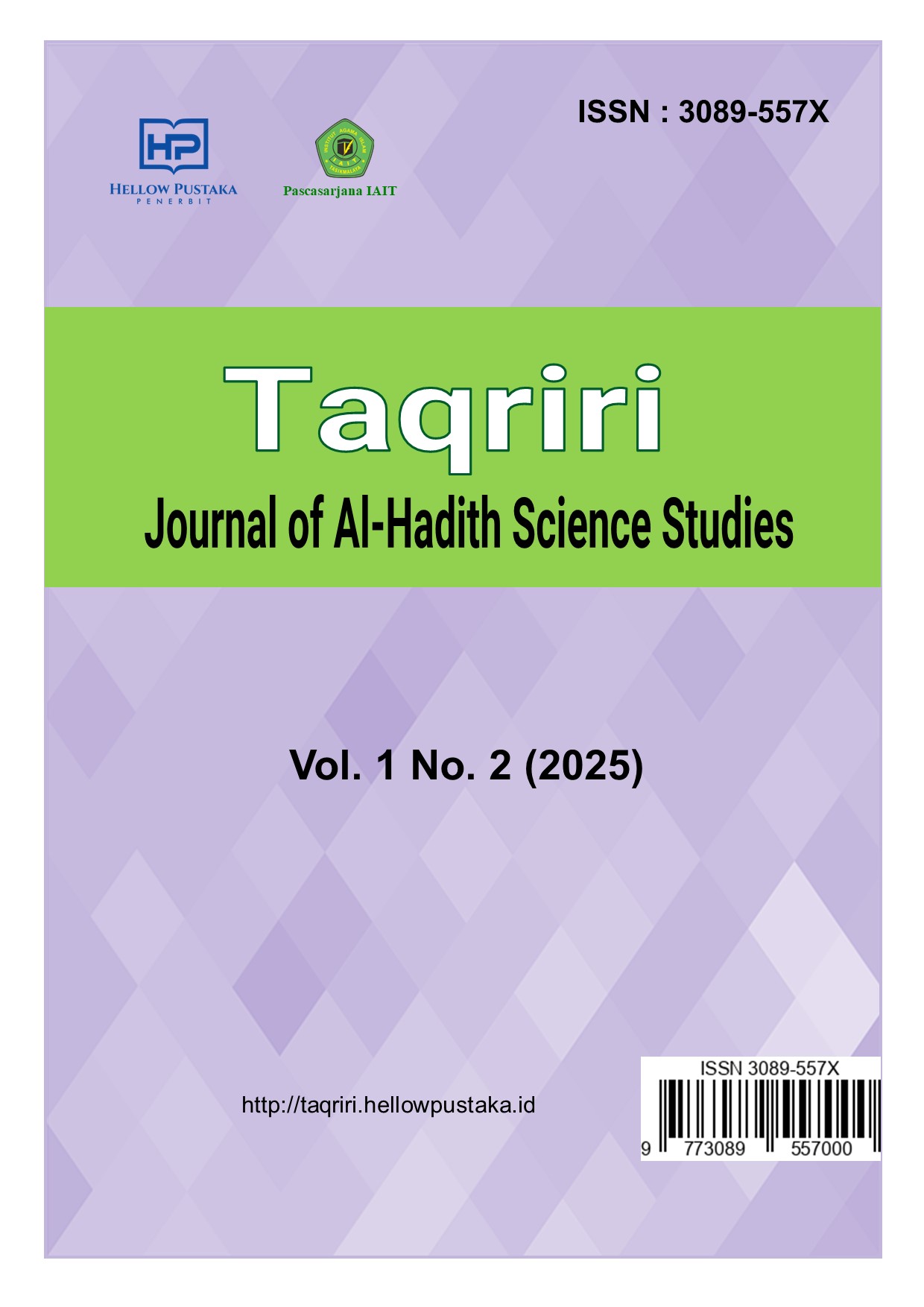
Hadith Classification (Saheeh, Hasan, Dhaif, Maudhu')
DOI:
https://doi.org/10.61166/taqriri.v1i2.30Keywords:
Classification of Hadith, Sahih Hadith, Daif Hadith, Authenticity of Hadith.Abstract
Hadith constitutes the primary source of Islamic teachings after the Qur’an and plays a central role in shaping the theological, moral, and social foundations of the Muslim community. However, issues concerning the authenticity and validity of hadith have long been subjects of debate among both classical scholars and modern academics. Therefore, the classification of hadith serves as an essential instrument for assessing the validity and credibility of a hadith. This study aims to examine the criteria for hadith classification—namely sahih, hasan, da‘if, and maudhu‘—and to analyze the strengths and weaknesses of each category. This research employs a qualitative approach based on literature analysis by reviewing various classical and contemporary sources. The findings indicate that sahih hadith possess a continuous chain of transmission, narrators who are upright (‘adl) and precise (dhabit), and are free from defects (‘illat) and irregularities (shudhudh). Hasan hadith share similar characteristics with sahih hadith, although the narrators’ level of precision is relatively lower. Da‘if hadith are considered weak due to defects in their chain of transmission or text, while maudhu‘ hadith are fabricated narrations deliberately created. This study emphasizes that hadith classification is not only crucial for the science of hadith but also has significant implications for Islamic education and da‘wah practices. A proper understanding of hadith classification will assist educators and preachers in conveying authentic, systematic, and responsible Islamic teachings.
References
admin. “HADITS SHAHIH: KONSEP, KRITERIA, DAN OTORITASNYA DALAM ILMU HADITS.” ISNU Ponorogo, 17 Juli 2025. https://isnuponorogo.org/mengenal-hadits-shahih/.
“Hadis Palsu: Modus dan Solusi.” Artikel Mahasantri. Ma’had Aly Hasyim Asy’ari, 28 Februari 2018. https://tebuireng.ac.id/artikel/mahasantri/hadis-palsu-modus-dan-solusi/.
kh1l4f4h2015. “Macam-Macam Hadits Berdasarkan Kualitasnya.” PONPES Al Hasanah Bengkulu, 1 Oktober 2020. https://ponpes.alhasanah.sch.id/pengetahuan/macam-macam-hadits-berdasarkan-kualitasnya/.
“Membaca Peringkat Hadis.” Kajian Hadis. Ma’had Aly Hasyim Asy’ari, 4 April 2018. https://tebuireng.ac.id/kajian-hadis/membaca-peringkat-hadis/.
“Mengenal Hadits Shahih dan Hadits Hasan – Mahad Al ’Ilmi Yogyakarta.” Diakses 11 Desember 2025. https://mahadilmi.id/mengenal-hadits-shahih-dan-hadits-hasan/.
NU Online. “Empat Cara Mengetahui Hadits Palsu.” Diakses 12 Desember 2025. https://nu.or.id/ilmu-hadits/empat-cara-mengetahui-hadits-palsu-orcWl.
NU Online. “Sebab-sebab Hadits Menjadi Dhaif.” Diakses 12 Desember 2025. https://nu.or.id/ilmu-hadits/sebab-sebab-hadits-menjadi-dhaif-xdUVi.
“Pendekatan dalam Pedidikan Islam di Era Digital Perspektif Hadis Nabawi | Al Washliyah : Jurnal Penelitian Sosial dan Humaniora.” Diakses 11 Desember 2025. https://jurnal.alwashliyahkalsel.org/index.php/jsh/article/view/78.
Ramadhan, Vigar. “Telaah keempat: Menggali Kedalaman Hadis Hasan.” Artikel Ringan. Perpustakaan Ma’had Aly Tebuireng, 6 November 2024. https://perpus.tebuireng.ac.id/2024/11/06/telaah-keempat-menggali-kedalaman-hadis-hasan/.
Ridha, Kana Afanin. “Konten Religi Tanpa Verifikasi: Tantangan Literasi Hadits Di Era Platform Digital Dalam Perspektif Ulumul Hadis: Unverified Religious Content: Challenges of Hadith Literacy in the Era of Digital Platforms from the Perspective of Ulumul Hadith.” DIRASAH: Jurnal Kajian Islam 2, no. 2 (2025): 286–94.
al-Khatib, M. A. (1998). Ushul al-Hadits: ‘Ulumuhu wa Musthalahuhu. Beirut: Dar al-Fikr.
al-Salih, S. (1986). ‘Ulum al-Hadits wa Musthalahuhu. Beirut: Dar al-‘Ilm li al-Malayin.
Azami, M. M. (2002). Studies in Hadith Methodology and Literature. Kuala Lumpur: Islamic Book Trust.
Ismail, M. S. (1995). Kaedah Kesahihan Sanad Hadits. Jakarta: Bulan Bintang.
bin Ahmad, A. H. M. (2018). Musthalah al-Hadits. Malang: UIN Press
Downloads
Published
How to Cite
Issue
Section
License
Copyright (c) 2025 Ari Afwan Hidayat Azizurrizzqi, Ahmad Mohammad Tidjani, Abdul Kirom

This work is licensed under a Creative Commons Attribution 4.0 International License.